Prof. Joe Meyer's LACC Poli. Sci. 1
Week 2 - Chapter 2

For extra credit...Do the pre-test - then read the book, then take the post test and chapter exam for each chapter as we cover it.... Don't need Extra Credit? Then read the text - then read my web page ... do the week's work - wow - that's a lot of reading - what is this? ... college? ... online? ... oh yeah ...
Why "Back then" never was.
Part I. What is an American?
To help you focus in on some terms from your text, each week I will list a few here. I may also add a few as time goes by.
politics
pluralists & elitists
social contract
majority rule/minority rights
power
Articles of Confederation.
Shay's Rebellion
Constitutional Convention
Bill of Rights
Federalism
Separation of powers
Checks and balances
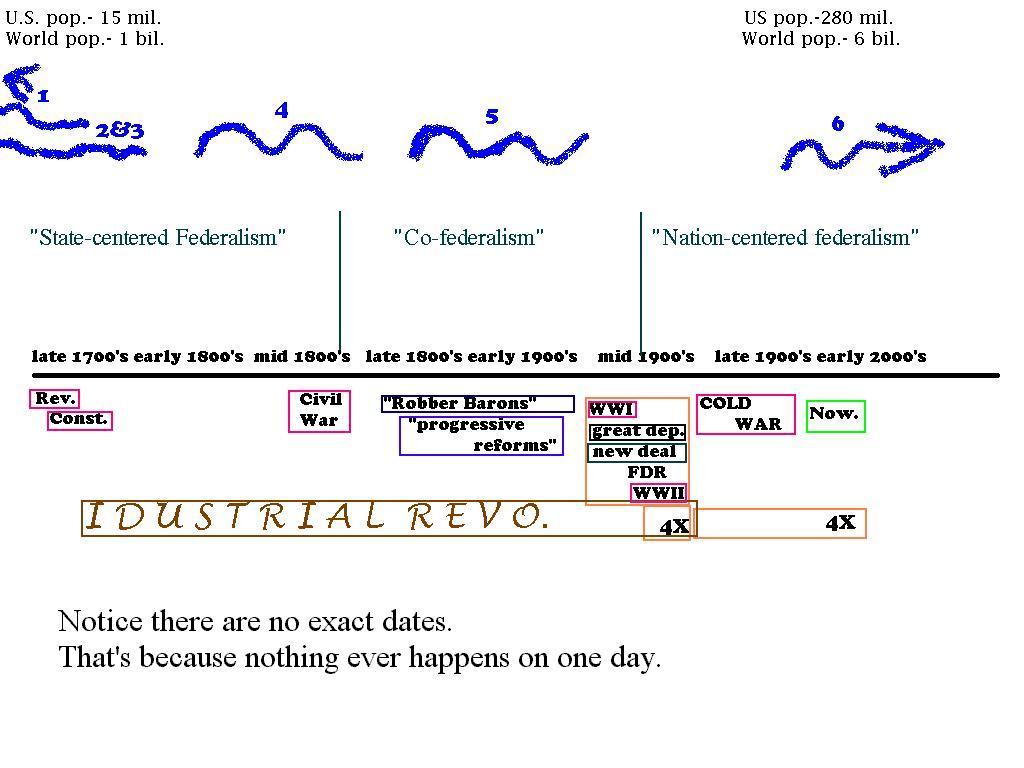
Here is a time line I drew up for you:
Poli. Sci. ain't History...
It is often said, and there is much truth in it that history is something that never happened written by some one who wasn't there.
The Winners Write the History
I told you last week what I thought of history, but here's something else to consider: The winners write the history. Even if the losers get to write it, it's kept in the winner's libraries. The winners write the history.
Have you ever heard of the "French & Indian War?" By the name, you'd think the French fought the Indians. But it took place in the mid 1700's and the British fought the French for control of the new world by hiring Indian tribes to fight each other. Similarly, the "Last Sioux Uprising" or the "End of the Sioux Wars" was the exact same thing as the massacre at Wounded Knee.
We can still learn from history even if we can't know what "really" happened. We can learn from myth as well as fact.
Back Then had a history...
Before we can talk about our country's history, we have to keep it in context. In the last 300-400 years humanity has changed more than it had changed throughout it's history. Many of the ideas you and I take for granted have only been generated, dispersed and accepted by people in the last few hundred years.
We are all products of "Enlightenment." Historians will argue when and where the Enlightenment happened, but by 1776 everyone who was literate in the Western World had heard of the radical ideas of the enlightenment and most European governments were experimenting with enlightenment concepts or rights and liberty. But they were all still monarchies based in the old feudal view of the world.
We all believe in the basic concepts of the enlightenment (at least the first two), even if we've never heard of them. Progress is the belief that things, our lives, everything, can and should "get better." Rationalism is the belief that we make things better by using our brains and bodies, not just by praying. And the last concept, Deism, was a vague belief in God.
The ideas behind the social contract and civil liberties comes from this tradition.
Are you an American?...
So what is an American? American could mean South American or North American, but most people around the world don't use it that way. When they say American, they mean people from the USA; from our culture.
So what are the defining characteristics of American culture? Traditionally three theses were put forth. The Puritan Thesis which held that Americans were moral God-fearing hard working Christians (often called the Protestant work ethic). The second thesis was called the Frontier Thesis. It held that Americans are bold adventurers who have made their own success and wealth. The third thesis, which many people still believe is called the Melting Pot. America is a mixture of races and ethnic groups who all blend together… Some say it's a salad bowl because we can retain our distinct flavors but accent each other…
This is all just plain silly. What if I'm allergic to tomatoes? I can remove them from my salad but if I hate my neighbor I can move or learn to live with him.
We can identify aspects of culture that are strongest in the US. We are materialistic consumers of consumables. We prize individualism and property. We prize youth and technology. We have serious racial problems and enormous social change. We have an unprecedented ability to move geographically, socially and economically. In the debate over security vs. freedom, our culture trends to pick freedom.
But if you ask me, what an American is, I'll tell you an American is an immigrant, or descendant of an immigrant.
The Six Waves of Immigration...
There are no true Native American because humans are not native to the New World. Today's Native Americans are descendants of the first immigrants. Maybe 15,000, maybe 50,000 years ago humans first came to the new world. The traditional explanation is the Bering Land Bridge, but recent finds challenge that view - maybe humans came to the new world even earlier, or in other ways. But regardless, humans emigrated here to north and south America and really none of us are true natives
The first wave was a looooonnnngggg time ago.
The second and third waves came together. Or I should say the second wave brought the third. The European explorers and settlers also brought slaves. Slave importation ended in the early 1800's, but the second wave had slowed before that. Slave importation became increasingly expensive and there were ample numbers of slaves to continue to bred a large slave population.
The fourth wave came in the mid 1800's. They were mostly poor Europeans.
The fifth wave came in the late 1800's and early 1900's. The big difference between the two isn't just when they happened but what happened to the new arrivals. Those who came in wave four were more able to move west (to what is now called the mid-west) where those who arrived in the fifth wave often got stuck on the east coast.
And the sixth wave is going on right now. It started in the late 1970's. This last decade of immigration (1990-2000) is second only to the first decade of the same century (1900-1910) for number of immigrants. Today one out of ever ten Americans is an immigrant. In Southern California, it's one out of four.
So all these "immigrant issues" about language and the like are not new. (Before WWI, my hometown of Milwaukee had more German language newspapers than English.) They are part of America, the land of immigrants. Look at the population numbers. We've become the country we are because of immigrants.
Part II - Who's My Founding Father?…
When we hear the term "Founding Fathers" it creates an emotional reaction. It's not a scientific term at all. It's supposed to bring up warm feelings of patriotism. In political science, we choose to avoid such terms and look at the details.
The "Declaration" and Constitution were not written by the same people.
There were two groups of "Founders." The group of men who wrote and approved the Declaration of Independence and the group of men who wrote the Constitution, almost ten years later.
After the Colonies had been at war with England for several years, the Continental Congress decided to declare war. They wrote the Declaration of Independence. As much a document written for European governments as for the people of the U.S., the Declaration stands as the most eloquent example of the ideas behind the social contract and the Enlightenment in general.
Read the Declaration some time, it's beautifully written.
(see page 399 of your text)
The Declaration is a wonderful example of Enlightenment thinking and the ideas behind the social contract.
"That to secure these rights, governments are instituted among Men, deriving their just powers from the consent of the governed. That whenever any Form of Government becomes destructive to these ends, it is the Right of the People to alter or abolish it…"
It goes on to say that if government reduces people to living under "absolute Despotism, it is their right, it is their duty, to throw off such a Government…"
Then it says all the horrible things the King of England has done. Towards the end, it even says the King has brought on "the inhabitants of our frontiers, the merciless Indian Savages…" Was it the King who brought on the Indians? Was it "our frontiers?"
Then in one sentence it ties up the social contract: "A Prince, whose character is thus marked by every act which may define a Tyrant, is unfit to be the ruler of a free people." That's it in a nutshell. Liberty needs democracy - or as they called it - "the consent of the governed."
The men of the Continental Congress were a mixed lot. None of them were poor and of course they were all white males. But they were a diverse group in terms of occupation, age, education and political experience, unlike the men who wrote the constitution.
We win the war, so now what?
So at the end of the first war the English Empire would lose to one of it's colonies (not the last), the United States was formed. Our first constitution was the Articles of Confederation, which treated each state almost like an independent country in a loose confederation. It's biggest failure was that all 13 states had to agree in order for the central government to do anything. That meant it usually did nothing.
Shays' rebellion was small compared to the L.A. riots of '92, but it demonstrated some serious problems with the Articles.
A Constitutional Convention was called to "revise the articles".
They revised them by creating an entirely new form of government.
But the men who attend this convention in hot Philadelphia during the summer were not like those Continental Congress guys, ten years before. This group was mostly lawyers and businessmen. Most of them held war bonds issued by the Continental Congress but not honored by the government of the Articles of Confederation. Did they do it for the money? No, that's not the point. They were politicians who knew what they were doing. Mostly, they wanted to scrap the Articles and come up with something better. They did it the same way everything is done in our system today, with compromise and consensus building.
I'm not an expert in history, but I know the Founders were simply practical politicians of their day. The "Great Compromise" between the New Jersey and Virginia plans also meant that slaves would be counted as three-fifths of a person. The new constitution nationalized slavery. It also put off the civil war for almost two generations.
Check this out:
The biggest thing that was accomplished was the establishment of a strong national government that was "checked" by the power of the states. That's a good word: "Check." Most people think it means to "check up" on some one, but it doesn't. Think: hockey check. To check means to stop an advance or a charge. That's what "check" means.
"Separation of Powers" really means all three branches stick their noses into each other's work. "Federalism," which we will discuss next week, and separation of powers are both attempts to spread power around the system. The idea is to give many people and institutions the ability and incentive to "check" each other. It's called "decentralized power." That's how we limit government, by setting up checks everywhere and hope that it will "balance."
Limited government is more important than democracy.
Democracy isn't a big deal if we don't have limited government. Limited government means government follows it's own well established, public generated rules. It allows for the minority to be heard against the majority. Limited government makes democracy a functional reality. If government doesn't limit itself, if we can't use the courts to limit it, if we can't demand that our representatives limit government, than all the constitutions and rights in the world won't protect us.
Mostly the guys with wigs and tights wanted government to leave them alone. They saw government as the biggest potential "bad guy" there is.. They wanted government to protect them but not to interfere with their commerce and their lives. In many ways their problem of how powerful a central government should be and how much liberty an individual should have is the central problem of human existence today:
Do you want Security or Freedom?
That's the question we all answer every day of our lives. We all want more freedom but at what cost? We all want more security but it is always at the cost of freedom. Life is funny that way, isn't it?
Something to Think About:
That's still a big question in the so-called Post 9/11 world: How much freedom do we give up for our security?
P.S.: I am no historian so I found a bunch of websites that do a much better job of discussing the days and dilemmas of the guys with the wigs and tights.
Some Related websites:
Check out the original documents and much more at the National Archives:
http://www.archives.gov/
An article by B.G. Kauffmann, “James Madison, Godfather of the Constitution:”
http://earlyamerica.com/review/summer97/madison.html
An academic account of the background of Constitutional Convention participants:
http://mondrian.princeton.edu/CampusWWW/Companion/constitutional_convention.html
To see how some other college classes are using this discussion topic:
http://www.icann.org/comments-mail/comment-so/msg00010.html
http://spider.georgetowncollege.edu/htallant/courses/his338/stu1-338.htm