Prof. Joe Meyer's LACC Poli. Sci. 1
Week 3 - Chapter 3

All issues are - at least in part - federalism issues...
Federalism and the "levels" of government.
So how many governments are there in the United States? One? Fifty state governments? How many cities, counties, towns, villages, and special districts are there around our country? Over 88,000
Often people complain about "the government" when they really have no idea what level of government is responsible for whatever it is that spurred their complaint. They see government as one large amorphous thing - but it really is people. About 25% of us who have jobs work for some level of government...me, a cop, the trash collector, a nurse, a hazmat responder, a park ranger.. we are all government employees .Government is very diverse.
Maybe you live in the City of LA where the trash and the cops both work directly for the city. Maybe you live in Lennox where LA Sheriffs patrol and the Hawthorne fire department responds. In the city of LA, DWP - a city department - provides water and electricity, but in parts of LA County, Edison, a for profit monopoly provides the power and a water district provides and charges for the water.
You could think of it like layers in a marble cake:
| US Federal Government |
|---|
California State Government |
| Local government (e.g.: city, special districts, etc.) |
Have you ever been in a relationship?
Of course you have, not just love but family, etc - those are all human relationships. I bet you are an expert in human relationships! So as an expert in human relationships, let me ask you do relationships (a) never change, or (b) always change over time?
It's b right?
So it is with Federalism. Federalism is nothing more than the relationship between the federal, central or national government and the governments of all the states. Each state is slightly different and so each state government is slightly different in the way in which they do politics, run elections, parties, etc..
Like all relationships, US federalism has changed over time...
Remember the time line I drew up for you:
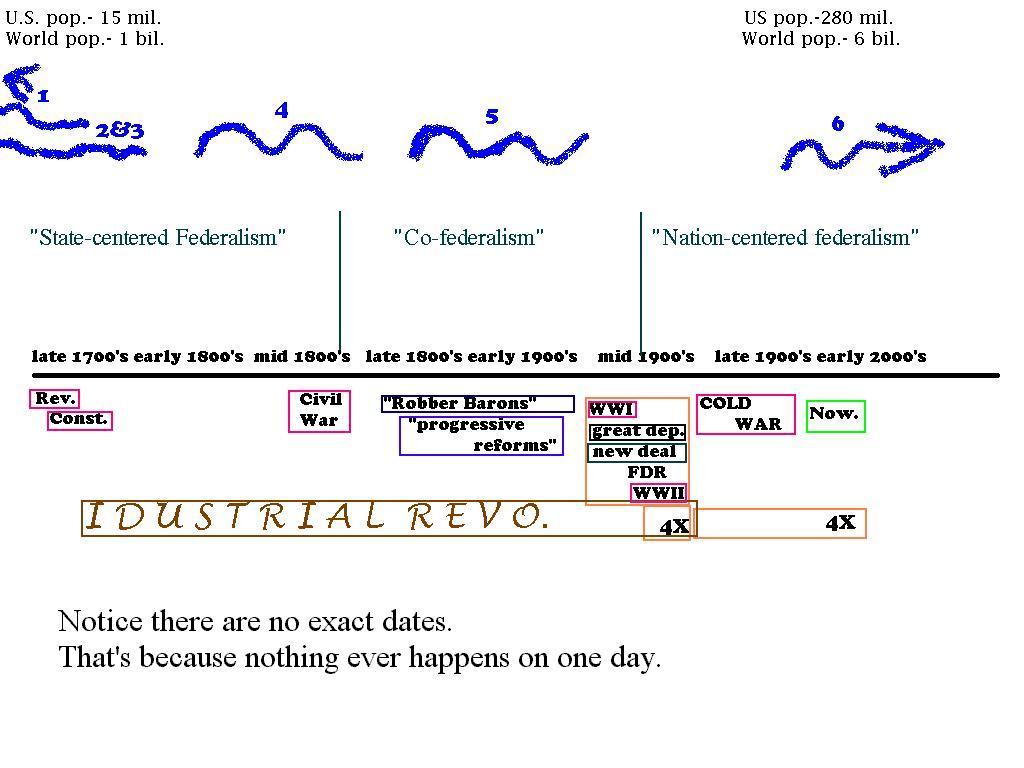
There have been three periods or phases to this relationship.
The first phase, State centered federalism: from the start of the country to the Civil War, has the states with almost all the power. There was no large standing national army, there was barley a navy...both because the state governments had most of the tax money and did not share it with the Federal government.
Of course the Civil war changes all that. It at least answers the question: can a state secede? But in a real sense it was the victory of ethnographer industrialists over the southern "planter class."
The Civil War was as much a clash of visions for America as anything else. Not that the northern industrial elites were so freedom loving that they cared about slavery, no.. but they did care about keeping the nation together.
Lincoln cared more about keeping the union together than he did about slavery, or carnage or blame.
The Civil War was the first modern war. The north had guns made in factories with interchangeable parts - think about how that makes the battle field more lethal - you can fix broken guns with parts of other guns - something not possible before that.
It was the first war to move tens of thousands of soldiers by train and into battle on the same day. The first war to use arial photography (from balloons), battlefield telegraphs, battlefield medicine involving washing the hands of the medical provider, first to use telegraphs to allow political leaders to make tactical and strategic decisions. It was trench warfare like the world would fight for the next 150 years..
But mostly the Civil War ended with the North clearly devastating the South and, it is often argued, the nation turned its sights west..
"Co-Federalism" the second era of federalism, sees the expansion of the US to the West coast, sees the near genocide of the Natives, the explosion of American industrialization and the growth of the Progressive movement (and all the social change that comes with it - eg: school reform, prison reform, child labor laws, marriage laws, etc...
What marks the end of the second era is the entire generation that came to power from World War I through the Great Depression and "NEW DEAL" to the current modern system.
Nation Centered federalism is called that because since FDR the debate has been about "how big" the federal government should be. But that is a simplistic way to look at it. Every president since FDR may have promised smaller government but under every president - the government GREW! - Even Reagan - Clinton saw a less than one per cent shrinkage of the total size of the federal government, according to his White House Office... George W Bush grew the government after 9/11 more than ANY president before him.
But face it - people want the federal government to "do" things, pay for things and decide things. That is called the "scope" of government - what people expect government to do (and thus what it tries to do).
Through out your life time and mine - the scope of the federal government has grow. So has the ability of the federal government to raise its own money and no longer be restricted by what the states might wish to pay.
But every issue is a federalism issue.
Pick any issue and at least part of the issue is which level of government should do what to help fix the problem. Homelessness? Crime? Terrorism? Crime? Civil Rights? Environmental protection? Food safety? Roads? etc.
Like Roe v Wade - really doesn't legalize abortion - what it says is that no state government can outlaw abortion. It does not address whether the federal government could outlaw abortion, nor does it say anything about funding. But what it means is that every state has to allow abortions to happen. Do all states have abortion clinics? As it turns out - the answer is no. So do women have a right to an abortion or is the government prohibited from outlawing abortions. Is it the same thing?
Who should pay for schools - K-12, Community Colleges? Cal. States? UCs? Should home owners subsidize public education (that's how it works now) or should only people with children pay for schools?
If the federal government says your school or city HAS to do something (its called a mandate) like ADA (Americans with Disabilities Act) but they don't include any money to pay for the cost of complying...is that fair? (unfounded mandate)
Think about any issue and at least part of the discussion has to be about which level of government should do (or not do) something. And which level of government should pay for it?
jj