Prof. Joe Meyer's LACC Poli. Sci. 1
Week 1 - Chapter1

Now we are up and running- no more excuses - let's get to work!
Introduction: What is Political Science?
"This being a world of competing moral principles and conflict among them, absolute good can never be attained. Moral principles can never be fully realized. But at best, must be approximated through the ever temporary balancing of conflicts and the ever precarious settlement of disputes…(thus)…politics is always the choice of the lesser of evils."
Hans Morgenthau , the person who said that, was the father of the School of Realism, one of the many schools of thought in political science.
He's right, politicians don't want to help people. They want power. They might want power so that they can help people, but how are we to know the minds of others?
My discipline, political science, is a unique way of looking at the world. It is a specialized lens through which to view all human behavior and it has a great deal to tell us about ourselves and others.
We don't just study governments. We study all group interaction. We study a simple concept: Power. Political Science seeks to describe explain and predict human behavior in terms of power. Where there are two or more humans there is a power relationship. You have power, I have power, we all do. But is it the same? Do we all use our power in a similar fashion?
Political Science - one of many Social Sciences.
First, understand that political science is one of the many social sciences. The social sciences have only been developed in the last century or so. And in the last fifty years, the advance in computers has allowed most social science to take place. Computers allow the analysis of huge amounts of data, allowing social scientists to do their job: scientifically describe, explain and predict human behavior.
Political science is a wannabe science like all the other social sciences. Where physics and chemistry get to do lab experiments, we social scientists can only observe institutions and governments as they do experiments (policies). But we follow the basic scientific method . You know the SCIENTIFIC METHOD don't you? If not visit this web site … and then go find your high school science teachers and yell at them. You got ripped off.
Political Science - a wannabe science.
So we use the scientific method to observe human behavior. We describe it, seek to explain it, and see if we can make predictions. Political science isn't as good at prediction as the so-called "hard sciences." Any one who tells you they saw the end of the cold war coming in 1985, they are just plan lying - no one did. But we still want to be able to predict human behavior. It's just that atoms, molecules, cells and weather fronts all are far more predictable than humans.
Political science studies group human behavior, not really individuals. We need data, numbers, verifiable reality is what we call it. Verifiable reality means something that we can see, hear touch, smell and reduce to some quantity or number. That you went to Disneyland can be verified and quantified (how many times, when etc.) but that you had fun - that can't be measured. Fun isn't a verifiable reality - it's outside our scientific ability to describe reality - it can't be mapped, or charted or any of that. (Unless you try real hard to have fun but then one person's fun may not be for someone else, so…)
Intentions don't matter. "Oh I didn't mean to kill him" but he's dead and that's the verifiable reality, not intentions. We study actions (means) and ends. Intentions can't be scientifically arrived at, nor can they be quantified (reduced to numbers). We have to have data - numbers - verifiable reality - in order to do political science.
I am a member of two professional organizations: The American Political Science Association and International Studies Association.
Political Science is NOT like any other class.
This is not a psychology class and your feelings are irrelevant . That means your emotions are irrelevant (at best) and dangerous to your analysis (at worst). Does a biologist become emotionally attached to the frog she is dissecting? No. Leave your emotions aside and describe and explain what is, not what you wish or what you feel. Deal in verifiable reality, not your dreams, nor moral constructs, nor emotional baggage, but only that which is.
This is not an economics class. Economics is the least credible of the social sciences. Economists pretend their charts and graphs are connected to this thing they call a market. It's interesting fiction.
This is NOT a history class, although we will talk about some history and we can learn from it, remember, history is something that never happened written by some one who wasn't there. Historians love to deal in moral questions. Social science is not equipped to deal in moral issues. If you want answers to moral questions, take a philosophy class, a history class, pray, or do whatever works for you, but social science has no answers because we do not ask those questions. We don't make moral judgments. We try to leave our prejudices at the door, or at least admit them to ourselves as a way of controlling for their impact on our study.
"The perception of the facts is more important than the facts, moreover, the perception of the facts usually becomes the facts."
It's an old saying and no one is ever given credit for this quote, because like a good axiom, it's self defining.
Political Science doesn't seek "the truth." The truth is unascertainable, indefinable and rests in the hearts and minds of each individual. Is there is only one truth or is truth in the eye of the beholder? This is a world of competing world views and absolute truth is beside the point. People live their lives by what they know and believe to be true, not by what is true.
Questions about "truth" and all those noble concepts are best left to philosophy. Political science is a social science and we have a much simpler mission - describe explain and predict human group behavior in terms of power. This is not a philosophy class.
Verifiable Reality - Everyone has biases.
Because we exist, we all have biases. But political science deals in "verifiable reality" (That which is, described in terms of data), not broad sweeping insupportable statements. That's how we can talk about race, poverty or other issues and not be accused of being racists or whatever.
Quantifiable Reality - Measurable Reality.
In Social Science inquiry, we have to use variables that can be measured, or reduced to a numerical quantity. So concepts like love, passion, trust and a thousand others are difficult for us to use in our analysis. that is the focus of social science inquiry - that we separate the emotion and look at the reality of any situation.
People often say that statistics can be used to prove anything or that statistics lie. Statistics don't lie - people do. People lie. All people lie. Throughout their life - people lie. Don't blame the liar for lying, blame yourself for believing a liar.
Maybe not an axiom, but a great piece of advice: "Define your terms." This means YOU must define what is important to you. In writing papers, you can't just throw out some word without defining it. And don't use the dictionary - you can start there but grow up! All worth-while and interesting adult discourse deals with defining terms that matter.
Structure and Function.
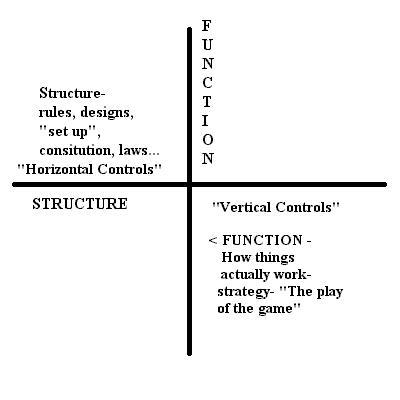
This brings up a great concept that you should use in your "real life." The Structure of something refers to the rules of it's operation, how things are supposed to work (The Constitution, laws etc.). The Function refers to how things actually work. Political science reminds us to always look beyond the structure to the function.
The All-Important Effect of Culture.
Our government was set up a long time ago, but it was and is a product of our culture. Culture sets the limits for political action. No politician can act outside of his or her culture and remain in power. You and I are equally stuck in our culture because it is such a huge part of what we are. Even if you go somewhere else, the culture you were raised in follows you, it is part of you.
Culture is everywhere.
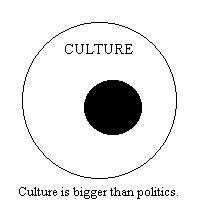
If the dark circle is all that there is to know about political science, the larger circle represents all there is to know about culture. Culture is always an important variable to remember. No one can really act outside her or his culture. Especially not politicians.
Which government? Which level of government?
How many governments are there in the U.S. today? One? Fifty one? Try over 88,000. With the states, counties, cities, special districts - there are many governments in the U.S. So the next time some one says: "The problem with government is…" They don't know what they are talking about.
Or people who say: "government is just like…" It's not like anything. Name something that is more complicated and unpredictable than humans. Atoms? Quarks? Advanced Math? I don't think so.
The structure does matter - as a starting point if nothing else. Federalism (which we'll see is the relationship among the levels of government) spreads the power around. Governors, states' legislatures and state and local courts all have a great deal of power.
This "decentralized power" is an important aspect of our democracy. Power is spread around the branches of the federal government and among the states.
We'll see throughout the semester that our governments have been set up to be SLOW. At the heart is always infighting and compromise. And everything is a Process. Nothing happens "overnight."
Politics Never Stop!
No subject ever really goes away - no serious social problem is ever "fixed" and "settled." Everything is open to debate in a process that is neither equal nor fair, but that's life. One of the true tragedies (and realities) of life is that LIFE does indeed go on and on and on…
Informal power - the ability to persuade.
Clinton may have been the commander-in-chief of the armed forces so why didn't he just order the military to accept gays? Was he a wimp, or is it because he knew that order would not be followed? He knew his own limits. Sure he had the formal authority, but what good is that if the order isn't carried out? Will the next order be viewed in the same light?
Every successful Politician (from FDR to Hitler to Stalin to Clinton) has followed the Six Tactics of Persuasion. They are the same, even if the culture in which they are practiced is different. These tactic of persuasion can be sued by parents to send their child to bed or by presidents wanting senators to pass a bill. They are the key to every successful person's life, even if that person has never heard of them.
The Six Tactics of Persuasion. ( R. Neustadt , Presidential Power )
So you want some one (or group) to do something. Your power and credibility is limited and finite (no matter who you are) so you should always be aware of it and conserve it. Use it to make it stronger, or mis-use it and lose it.
What's the easiest way to get some one to do something?
(1) Ask - explain your position.
It may not be enough to get people to do what you want, but if it is, then why do any more than that?
Maybe asking isn't enough - do the second tactic -
(2) Make an emotional appeal.
Don't appeal to your own emotions. If you want others to do things then you must stay focused on others and appeal to their emotions. The Parent who says: "Do it 'cause I'm the Dad and I said so." Can only say this if he has done his work as a parent and the child has a positive definition of "dad." LBJ (President Johnson) used to have his staff wake him in the middle of the night so he could call senators and wake them to remind them: "tomorrow, your country needs you to vote…" All successful politicians stay focused on others, not on themselves.
If the first two tactics don't work, you need to move to the third tactic.
(3) Make a vague promise.
Why a vague promise? So you don't have to keep it? No, just the opposite, make a vague promise so that you CAN keep it. I'm sure you've all been told by someone: "I'll look into it and see what can be done." And you knew they were blowing you off. Did you go back to that person? But if someone told you that and then came back to you and said: "I looked into it and we can't help you, but those guys over there can." That person has helped you (and those other guys) and has gained credibility from you (and those other guys).
(4) Call in past favors. This is where you use guilt, don't squander guilt at tactic #2. Guilt is finite. In order to call in past favors that means that politicians help people? What's this? Hitler helped people? Sadam Hussein helps people? Yes. All people? No only those people who keep him in power. Just like Clinton, Reagan, Churchill or whomever, just a different culture. If you want power, do things for people. If you want to amass power and enhance your credibility, get positive things done for people.
(5) Grant a current favor.
Unlike the promise, keep this specific and limited. If you start here, everyone will want something, so be careful what favors you grant. The more you do, the more people will ask, the more you will be able to do, the more past favors to call in…
(6) Threaten reprisals.
T his doesn't necessarily mean violence, but violence is part of the human condition. If politics is like your book says: "deciding who gets what, when and how" then when someone doesn't get their's they may perceive violence has been done to them. A reprisal may be: "Do this or I won't talk to you again." But don't threaten anything you can't do, or wouldn't do. In fact what you think doesn't matter. The other must perceive you as having the ability and the will to carry out the threat. Don't threaten anything that will cost you more than what you get if the person does what you want.
I believe it was Isaac Asimov who wrote: "Violence is the final refuge of the incompetent."
As we look at each chapter, keep these tactics in mind. Given that our society is full of people, maybe power is the ability to "work and play well with others." Or maybe, power is just getting anything done at all.
Something to think about:
How much power do you have in your life? What titles or formal authorities do you have? How do they relate to your actual ability to get things accomplished in your life? Do you use the tactics of persuasion in your life? Maybe you should.